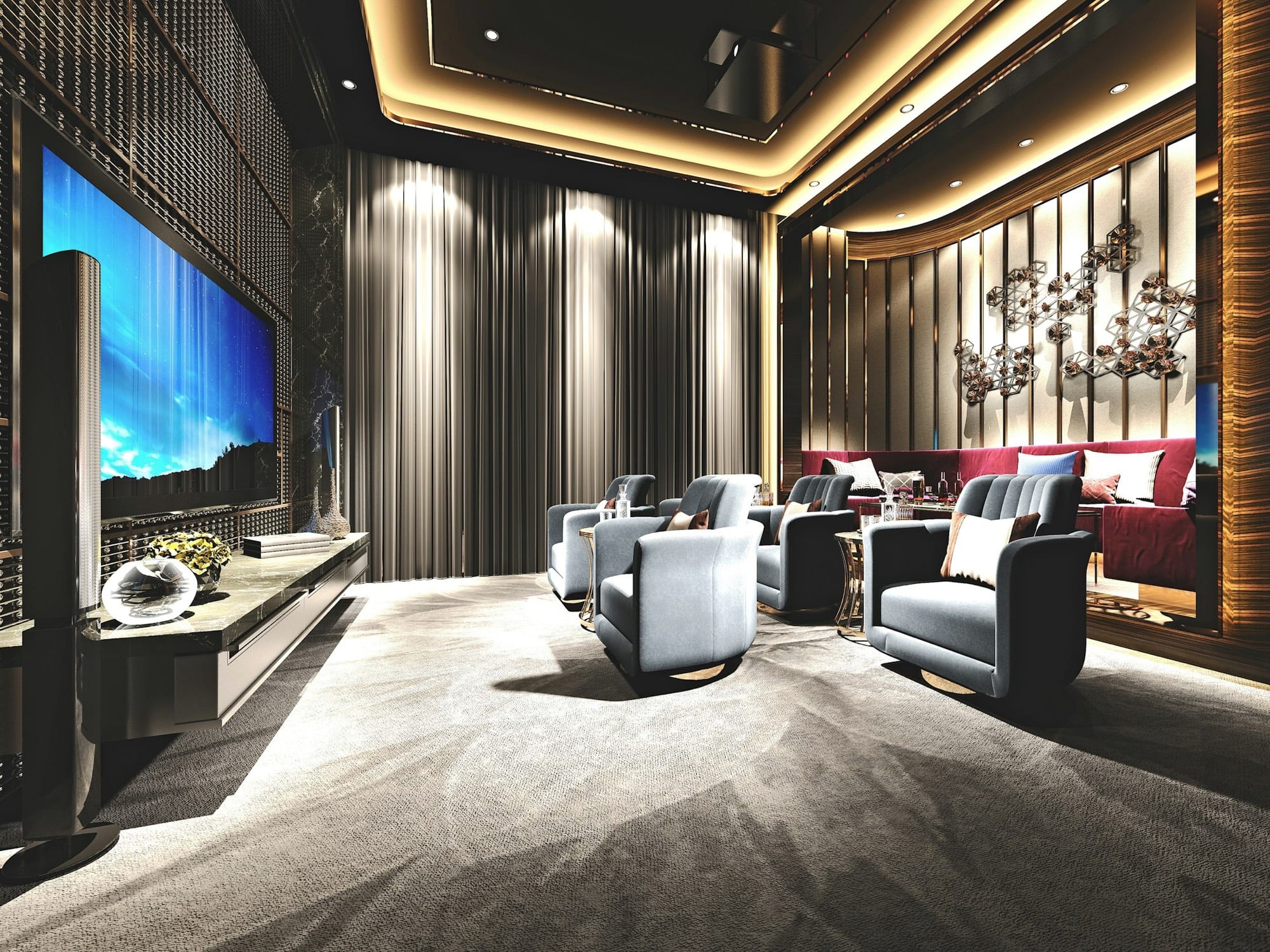
Home theater · Kansas City
Home theater installation in Kansas City. A theater is a room first.
Dedicated theaters and media rooms across the Kansas City metro, designed from a Control4 Certified Showroom in Overland Park.
The difference is not the equipment list. It is that the room has one job.
Show the full introductionHide the full introduction
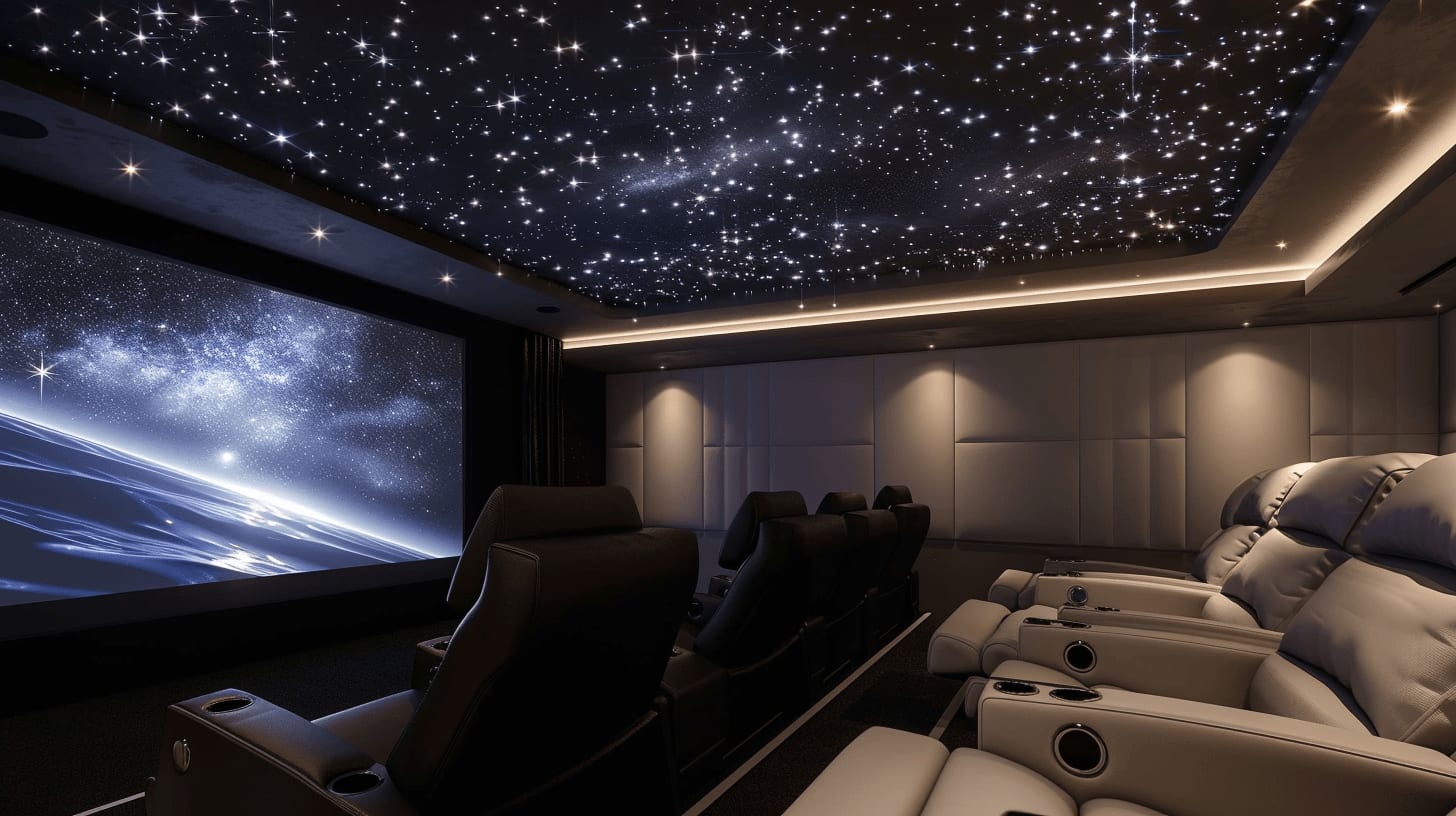
IntegrateIT designs and installs dedicated home theaters across the Kansas City metro from a design center at 15108 Glenwood Ave in Overland Park, Kansas: Dolby Atmos 7.2.4 and 9.2.6 layouts, laser projection on an acoustically transparent screen, CEDIA RP-22 acoustic treatment designed to the room, starlight ceilings and one-touch scene control, calibrated once the seats are in.
Judge any theater bid on four things you can verify: the manufacturer dealer tier in writing, an acoustic design with a measured RT60 target, calibration done after the seats are installed, and what the labor warranty covers.
Three ways we build it
The room decides which one.
- I
Dedicated theater
A purpose-built cinema room with acoustic treatment, tiered seating and reference projection, in a space that does nothing else.
- II
Media room
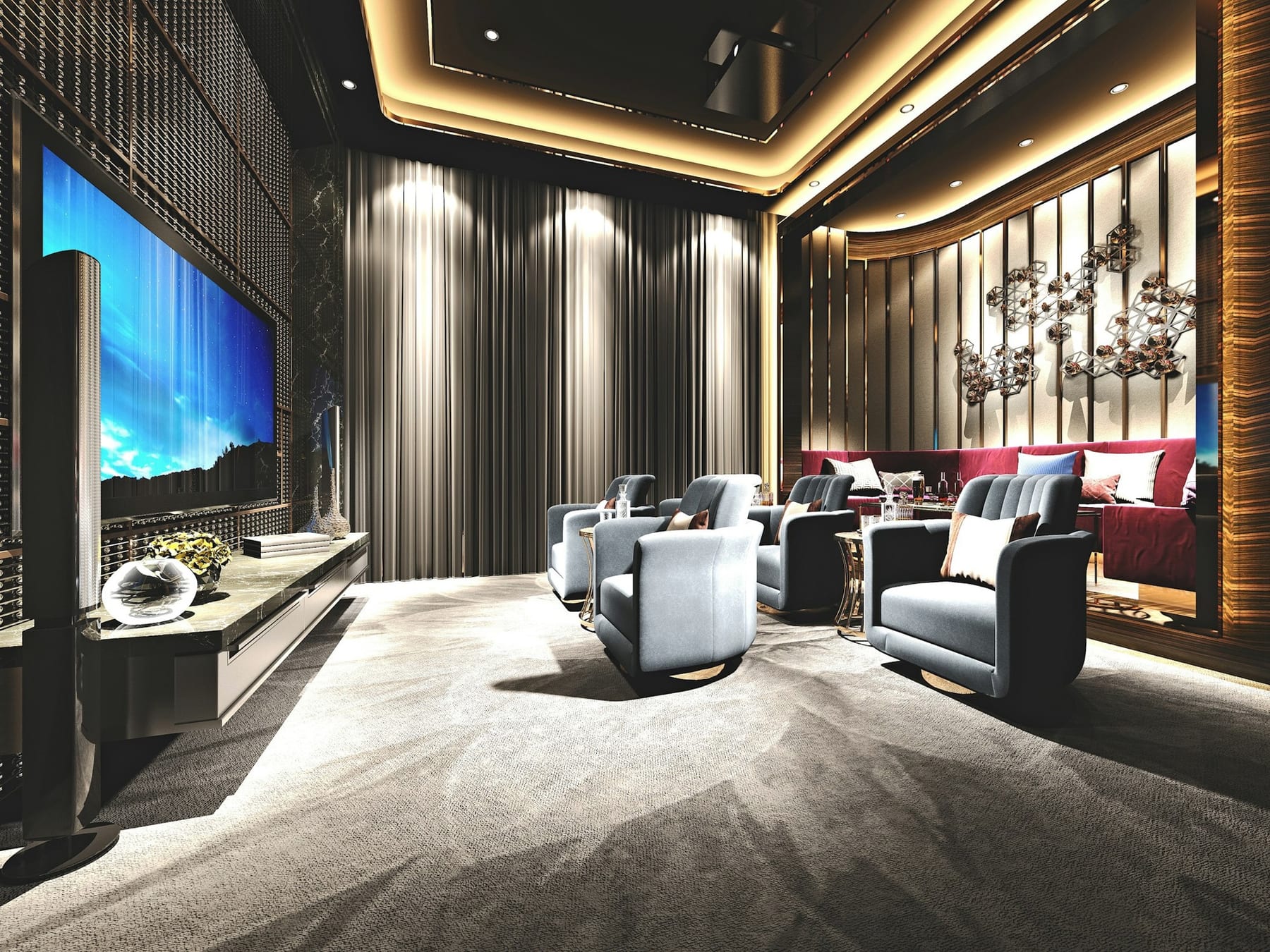
Theater-grade picture and object-based Dolby Atmos or DTS:X sound in a room the family actually uses: short-throw laser or a large-format display, in-ceiling height channels, an ambient-light-rejecting screen.
- III
Living-room theater
A large-format display or a discreet projector, in-wall LCR speakers, hidden subwoofers and 4K HDR video processing, in the room you already live in.
This page stays the general one — how to choose, how to compare, what the room does to the design. Three of its subjects have grown their own pages, because the questions people ask about them are longer than a bullet: the dedicated cinema as a build — isolation, sight lines, screen and projection, concealment, and the order the work runs in; Dolby Atmos as a room-design problem — how many height channels a ceiling can carry and whether they go in it or bounce off it; and calibration on its own, including the rooms we did not build.
When we are not the right answer: if you want a 75-inch TV on a wall with a soundbar, hire a TV mounter and keep your money.
Kansas City rooms
What a Kansas City basement does to the design.
Many of the theaters we are asked to build here are basement theaters, and the basement decides more than the budget does.
01Ceiling height is the first constraint, and it costs you twice.
A poured nine-foot basement wall does not give you nine feet of theater. Once the joist bays, the ductwork and the ceiling assembly are in, what is left is meaningfully less — and that remainder still has to absorb a second-row riser, seven to twelve inches for a proper sight line over the front row, and leave the Atmos height channels above and outside the seating. Under roughly eight feet of finished height, no budget buys a good result, and we would rather say so than build it. That arithmetic is why two houses four miles apart in Overland Park can support very different theaters, and why the tape measure comes out before the drawing does.
02The supply trunk runs where you want the projector.
The main HVAC trunk very often runs the long dimension of the basement — directly through the projector line or the ceiling-speaker layout. Rerouting it is real HVAC scope. It belongs inside the bid or explicitly outside it, and "we'll figure it out" is not a third option.
03Poured concrete walls are a gift; the other three surfaces are the work.
Concrete is an excellent bass boundary, which is part of why KC basements can sound genuinely good. The problems are the stud wall to the rest of the finished basement, the door, and the joist ceiling that transmits straight into the kitchen above. Decoupling that ceiling — resilient channel or isolation clips with hat channel, double drywall with damping compound — plus a solid-core door with a full perimeter seal is what keeps a 10 p.m. movie from being a family event. The full treatment method is on our theater acoustic treatment page.
04Keep the mechanical room and the rack out of the room.
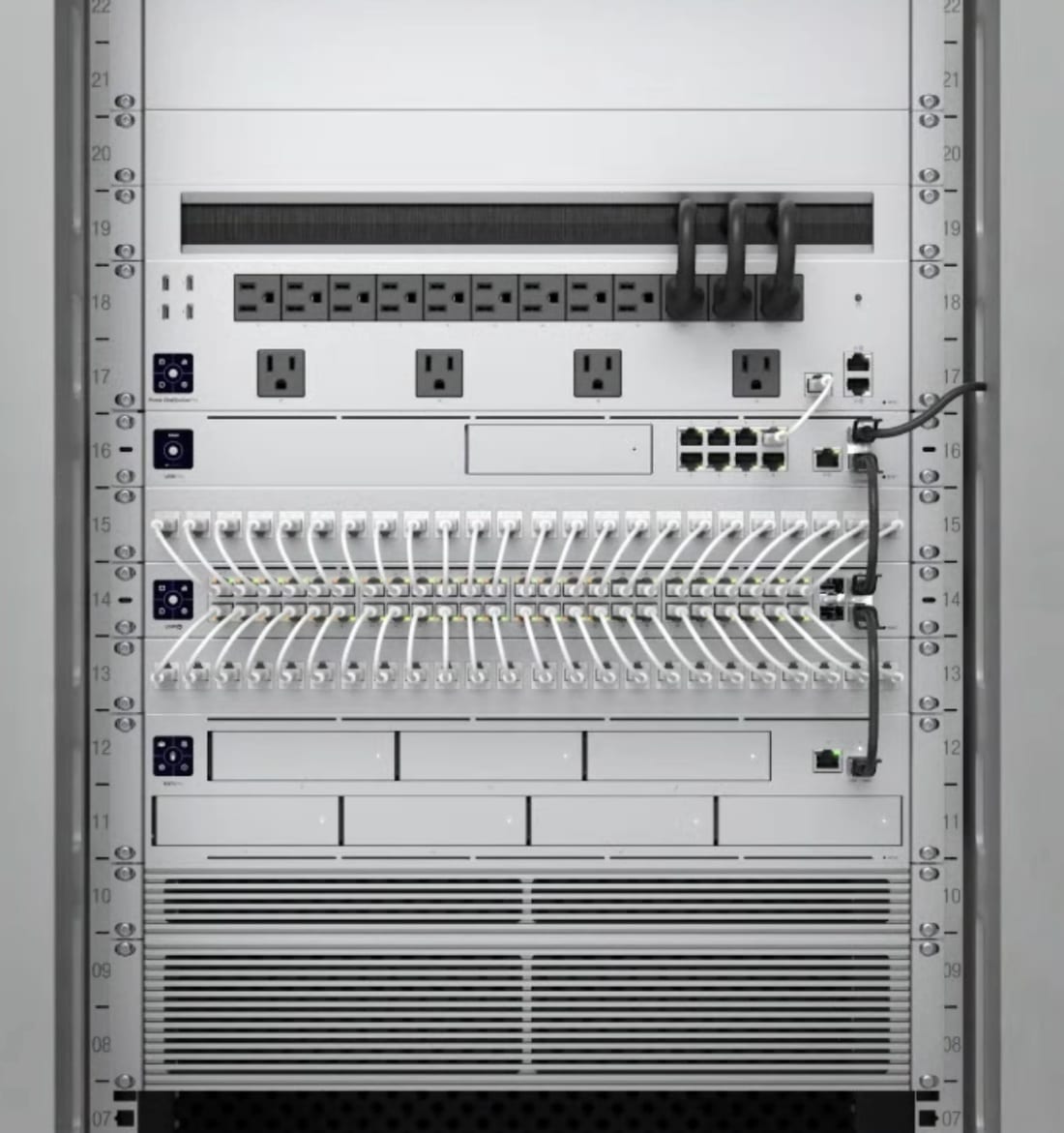
Furnace, water heater, and sump pump all cycle mid-movie. Put a wall and a door between them and the seats, and put the equipment rack in a ventilated closet on its own circuit — never in the theater, where its fans become part of your noise floor.
05Older housing stock east of State Line is a different answer.
Brookside, Waldo, the older Prairie Village and Mission Hills blocks: stone or block foundations, lower headroom, and rarely a square corner in the building. Those homes are usually better served by an excellent media room than by a dedicated cinema, and pretending otherwise is how people end up with a theater they duck to enter.
06Two more local facts.
Overland Park, Leawood, Olathe, Lenexa, and Kansas City, MO each run their own building department — somebody has to pull the electrical permit for the dedicated circuits, and your proposal should say who. And a finished basement here in August needs a dehumidification plan, or the screen material and the seating leather age on a schedule nobody warned you about.
Home theater design
Home theater design: the order we work in
We draw a theater in a fixed order, because each decision limits the next one: the room and the main seat first, then the screen size and the sight lines, then the speaker layout, then the acoustic treatment, and calibration last, from the seats, once the seating and the treatment are in. Taken out of order, a room gets designed around a projector instead of around the people watching it.
Each step has its own chapter below: the main seat and the room drawn around it, the acoustic treatment, the speaker layout and the picture and its calibration.
01Design & seating
Set the main seat. Then draw the room around it.
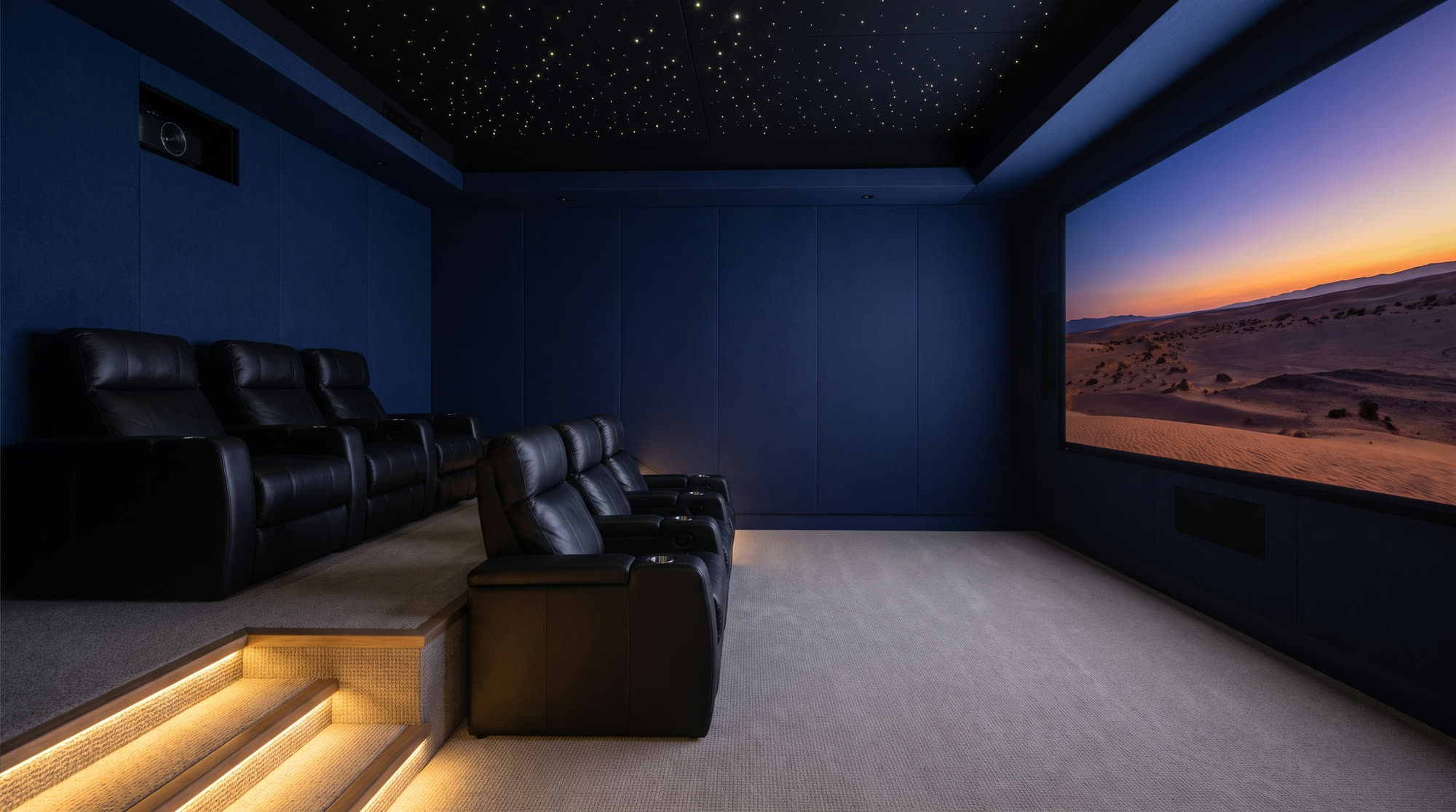
The screen size, the speaker angles, the riser and the calibration are all referenced to one chair, so that chair is settled before anything else. Then the rows are laid out so nobody in the second row is watching over a head.
A dedicated room sizes the floor plan to the screen instead of the other way round, and it is where the basement decides more than the budget does: under roughly eight feet of finished height, no budget buys a good result.
- Main seat first
- Screen, speaker angles and calibration all reference it
- Riser 7–12 in
- CEDIA RP-22 §3.2 geometry, worked against the actual seat height
- Ceiling height first
- Measured, with the joist direction, the columns and the HVAC trunk
02Acoustics
Dialogue you can hear is a number we measure.
RT60 is how long sound takes to decay by 60 decibels after the source stops. Every dedicated theater is designed to a CEDIA RP-22 §4.2.3 target of 0.30–0.45 seconds at 500 Hz, predicted with Sabine math before the build and measured with a sweep after it. Under that range the room feels dead; over it, dialogue smears.
0.30–0.45s · RT60 at 500 Hz
- Isolation
- Resilient channel or isolation clips on the joist ceiling, a second layer of drywall with damping compound, a solid-core door with a full perimeter seal.
- Bass
- Thick broadband traps in all four corners; two subwoofers placed by measurement so the bass sums evenly at every seat.
- Reflections
- Two-inch rigid fiberglass at the first-reflection points on the side walls, a four-inch cloud above the main seat.
- Finish
- Diffusion across the back wall, heavy carpet with a proper pad, and a screen wall built for it.
03Dolby Atmos
Atmos is a layout, not a quality level.
Count it as three numbers: the ear-level bed around the seats, the subwoofers, and the height channels overhead. A dedicated basement theater here is usually drawn as 7.2.4 or 9.2.6; a media room more often lands at 5.1.2 or 7.1.4. In-ceiling wins whenever the ceiling can be opened: four real overheads outperform six bounced ones.
- Ear level
- 7
- Subwoofers
- 2
- Overhead
- 4
Dedicated theater How a dedicated basement theater here is usually drawn: seven at ear level, two subwoofers placed by measurement so the bass sums evenly at every seat, four in-ceiling heights.
04Picture & calibration
Calibrated from the seats, after the seats are in.
Brightness and black level, contrast and peak white, gamma, white balance and colour: set from the actual listening positions, on the room's own processor, with the settings handed over in writing. Projector alignment uses optical lens shift and zoom rather than digital keystone, and focus is checked at the corners.
Calibrating before the seats and the treatment are in measures a room that no longer exists by the time you use it.
- Screen
- Acoustically transparent, with the centre channel behind the picture, where dialogue belongs
- Light
- Contrast lives or dies on the last ten percent of the dimming curve, so the lighting plan is drawn with the theater
- Source
- Kaleidescape for the film library, 4K HDR processing for everything else
05Control
One press. The room does the rest.
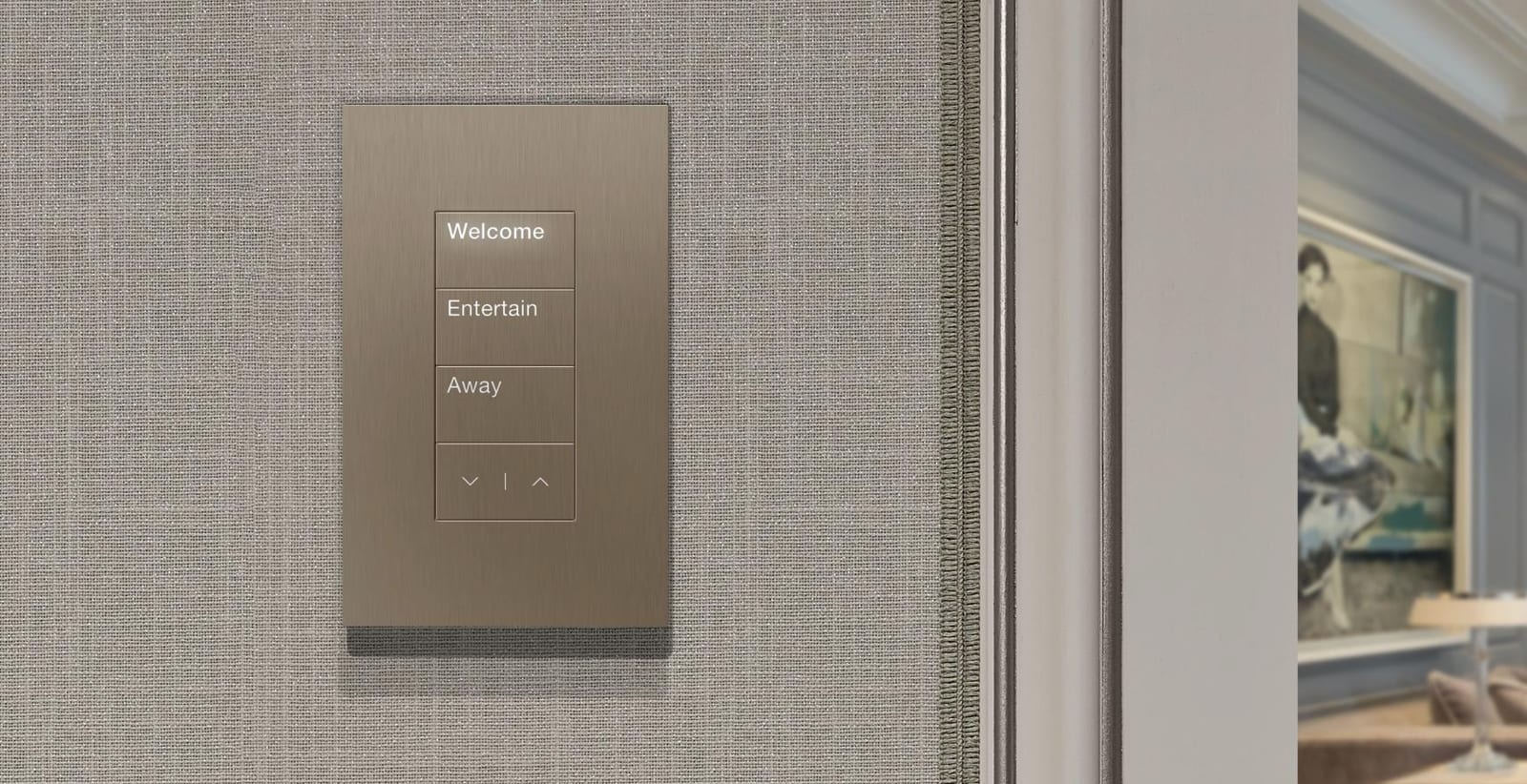
A Crestron or Control4 processor behind the wall, scene buttons on a touch panel or an engraved keypad by the door. Nobody in the house needs to know which input the projector is on.
- MovieDims the room, brings the stars up, starts the film.
- IntermissionRaises the ambient light enough to walk out; the picture holds.
- StarsA few thousand single-mode strands fed by a remote LED engine, with an optional twinkle wheel and shooting-star fiber, triggered by the scene.
The quiet parts
Details you should not see.
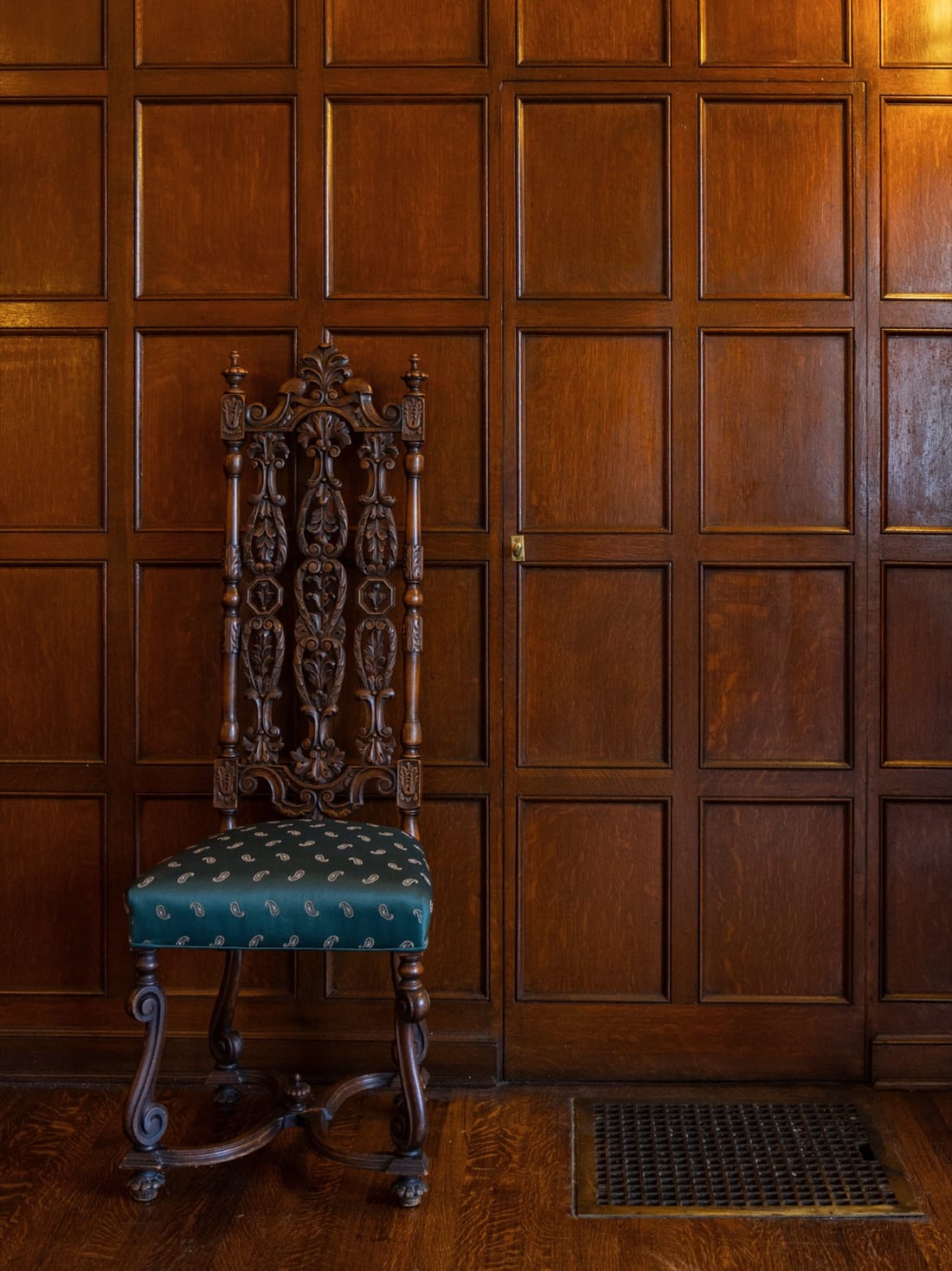
The equipment, the wiring and the door are the parts of a theater that are finished when nobody can find them.
The build
One scope, not a relay.
01Site walk & measurement
The ceiling, the joists, the HVAC trunk and the seats you have in mind, before any drawing.
02Room design
Isolation, acoustics, sight lines, screen size and the speaker layout settled together, because each one constrains the others.
03Coordination drawings
Issued to the architect, builder, electrician and mechanical trades, so the ceiling and the circuits arrive correct.
04Rough-in
Wire, boxes, isolation and the rack's dedicated circuit, while the walls are open.
05Finish & treatment
Panels, traps and diffusion, the screen wall, the seating, the starlight ceiling.
06Programming
One press runs the room.
07Calibration from the seats
Audio and video, after the seating and the treatment are in.
08Handover & support
Settings in writing, a five-year workmanship warranty from the final invoice, and support for as long as you own the system.
Theater lines
The platforms behind the work.
Authorized dealer10
- Kaleidescape

- James Loudspeaker
- Focal
- Stealth Acoustics
- Cinematech
- Elite HTS







We carry and install4

- JVC
- Triad



The dedicated room
What goes into the room.
01Speakers and amplification
Triad Platinum / Wisdom Audio in-wall LCRs, Triad Bronze / Sonance in-ceiling for surrounds and height channels, dual Triad Mini IW subwoofers. Trinnov Altitude32 processor with matched multi-channel power amplifiers.
02Display
Sony BRAVIA Projector 9 (VPL-XW8100ES, native 4K laser SXRD), JVC DLA-NZ900 laser D-ILA with 8K/e-shiftX, or Samsung The Wall MicroLED for the no-projector option. Stewart Filmscreen WallScreen Deluxe 120-150" 2.40:1 — perforated acoustically-transparent so the center speaker sits behind the screen.
03Acoustic treatment
OC-703 / OC-705 rigid fiberglass at first reflections, GIK Tri-Trap corner bass traps, RPG Skyline or QRD-7 rear-wall diffusion, heavy carpet floor, leather theater seating. Predicted RT60 0.30-0.45s @ 500Hz; validated post-install.
04Seating
CinemaTech / Elite HTS motorized recliners with cup heaters, USB charging, and motorized lumbar. Tiered platform construction for the back row(s) — riser height per CEDIA RP-22 §3.2 sight-line geometry.
05Starlight fiber-optic ceiling
A few thousand single-mode strands, remote LED engine, optional twinkle wheel and shooting-star fiber, scene-triggered with the rest of the room.
06One-touch control
Crestron CP4-N or Control4 EA-5 processor, scene buttons on a Crestron Mercury / Control4 touch panel, voice via Apple HomeKit / Amazon Alexa optional.
That bill of materials is the dedicated room. Two more projection lines we carry and install under distribution sit either side of it, and naming them is more useful than pretending every room deserves the list above. BenQ is the honest answer for the media-room build above — its Home Cinema and TV Projector ranges are designed for a room with light in it, where a reference projector spends its money on contrast the room will not let you see. Panasonic is the other direction: SOLID SHINE laser projectors organised by light engine and brightness, specified where a room runs all day — a simulator bay, a screening room in a club, a commercial-spec install — rather than for the black level a dark theater is built around.
Comparing bids
How to choose a home theater installer in Kansas City.
If you are collecting bids rather than picking a name, the rest of this page is the checklist we would want you to hold us to. Every row below is something you can verify before you sign — a dealer portal lookup, a line on a proposal, a number on a warranty document. Ask all nine of every bidder. The answers will separate them faster than the equipment lists will, because the equipment lists all look the same.
01The dealer tier, in writing
Why it separates biddersAnyone can source gear on the gray market. A tier is issued by the manufacturer, is checkable, and can be revoked — and it decides whether you get firmware, dealer support, and warranty standing.
Our answerControl4 Platinum Dealer with a Control4 Certified Showroom. Crestron Elite Partner. Lutron Certified Dealer.
02The acoustic drawing, and its RT60 target
Why it separates biddersIf the answer is a speaker brochure, the room was never designed. Treatment is also the easiest line to quietly omit, because nobody photographs it.
Our answerCEDIA RP-22 §4.2.3 design. Target RT60 0.30–0.45s at 500 Hz, predicted with Sabine math before the build, measured with a sweep after it.
03Whether the screen is acoustically transparent
Why it separates biddersAn AT screen puts the center channel behind the picture, where dialogue belongs. A cheaper matte-white screen forces the center speaker below the frame and pulls every voice out of the image plane. Big price delta, easy to hide in a lump sum.
Our answerPerforated acoustically transparent Stewart Filmscreen is the default in dedicated rooms, with the center behind it.
04The lighting plan
Why it separates biddersA theater's contrast lives or dies on the last ten percent of the dimming curve and on where the fixtures aren't. A theater bid with no lighting scope is half a bid.
Our answerLutron Certified Dealer. HomeWorks QSX where the walls are open and a panel makes sense, RadioRA 3 where they are not — the tier is decided by the house, not by the budget.
05The excluded scope, named on the same page as the included scope
Why it separates biddersFraming, drywall, the dedicated circuits, HVAC relocation, seating, and the permit are the five items that move silently between "in" and "out" of a proposal.
Our answerLine-item proposal with exclusions printed alongside inclusions, not in a follow-up email.
06When calibration happens
Why it separates biddersCalibrating before the seats and the treatment are in measures a room that no longer exists by the time you use it.
Our answerAfter the seats land, from the actual listening positions, on the room's own processor.
07What the labor warranty says
Why it separates biddersManufacturer warranties cover the box. Nothing covers the labor to get to the box unless the integrator writes that coverage themselves.
Our answer5-year workmanship warranty on our labor, in writing. Products keep their own manufacturer coverage.
08Who answers in year seven
Why it separates biddersIn our service work, most theater failures are not gear failures. They are a firmware change, an HDMI handshake that used to work, or an installer who left the industry.
Our answerOur own crew, not subcontractors — which is what makes a workmanship warranty possible to offer at all — plus ongoing service plans and support for as long as you own the system.
09Whether the room can also be a golf simulator
Why it separates biddersA dual-purpose room is a different structural, projection, and ceiling-height problem. If the simulator gets subbed out, you end up with two warranties and nobody owning the overlap.
Our answerWe are an authorized dealer for Foresight Sports and Trackman, so the launch monitor, the enclosure and the room are all inside one scope — one design, one crew, one workmanship warranty across the overlap.
Seven questions, in the order that matters
Show the seven questionsHide the seven questions
- "What is this room's RT60 target, and how did you get it?" Ask this first, before anyone says a brand name. A bidder who can answer it has done the room. A bidder who redirects to projector specs has done a quote.
- "Show me your dealer tier." Not "we install Control4." The tier. It takes thirty seconds to state and it is the cheapest lie to catch.
- "Did you measure my basement, or estimate it?" Finished ceiling height, joist direction, column locations, and where the HVAC trunk runs are the four numbers that constrain the whole design. If nobody crawled the mechanical room, the bid is fiction.
- "Line-item it." A lump sum is not comparable to anything. Ask for the screen, the projector, the amplification, the acoustic treatment, the seating, the electrical, and the labor broken out separately. Three bids become legible the moment they are itemized.
- "What is explicitly excluded?" Then read that list twice. This is where the second, unbudgeted contractor appears three weeks into the job.
- "What does calibration mean here, and when does it happen?" You want a real answer — measured, from the seats, after the room is finished.
- "Who services this in five years, and what does the labor warranty cover?" Ask it last so the answer isn't rehearsed. The theater will outlive the excitement of buying it.
Three bids, one number
Three Kansas City proposals can land within a few thousand dollars of each other and describe three genuinely different rooms. The gap is almost never the projector — projector model is the one line every bidder prints proudly. The gap is in the parts nobody photographs: whether the screen is perforated or matte white, whether the surrounds run off a receiver or off separate amplification, whether there is one subwoofer in a corner or two placed by measurement, whether "acoustic treatment" means rigid fiberglass at the first reflection points and traps in all four corners or six foam squares from an online store, and whether the room build — framing, drywall, decoupling, the dedicated circuits — is inside the number or waiting outside it.
We do not publish price bands, because two rooms that look identical from the doorway can be very different projects. What we do publish is what moves the number. The three shapes a theater takes, and what separates them, are laid out in our Kansas City home theater cost guide; the long version — including the section on when not to spend the money at all — is what a home theater really costs in Kansas City. We give a fixed price after a no-cost site walk. We do not quote a theater by email, because we cannot see your joists from here.
When we are not the right answer
If you want a 75-inch TV on a wall with a soundbar, hire a TV mounter and keep your money. If you have a fixed budget and want all of it spent on gear, a big-box installer will get you closer to that list than we will, because a meaningful share of what we charge goes into the room rather than the boxes. And if your basement gives you seven and a half feet of finished height with a trunk line down the middle, the honest recommendation is often a media room, not a dedicated theater — we would rather tell you that on the site walk than build the compromised version of the thing you asked for.
★ The room review
Find out what your room can actually become.
We read the room before anyone names a product: finished ceiling height, the beam and the ducts, the sight lines, the doors — and tell you plainly what it will do and what it will not.
- 01You tell us which room, what is in it today, and roughly how much finished height you have. Photos do most of the work here.
- 02We reply within one business day — typically by phone — and either answer from the photos or book the walk.
- 03You get the verdict before anyone quotes equipment: dedicated theater, media room, or a different room in the house.
The review is free, and it ends in findings plus options. If the photos answer it, we will not book a visit you do not need.
At the end of the job
What should a Kansas City home theater installer hand you when the room is finished?
When a home theater is finished, you should be able to check what you were given. IntegrateIT, a Control4 Platinum Dealer with a Control4 Certified Showroom in Overland Park, hands over the room calibrated from the seats, the settings in writing, a handover package on its own link, and a five-year workmanship warranty that starts at the final invoice.
The handover package does not expire when the crew leaves. It holds a guide to how the system works, the as-built equipment list with model and serial numbers, the warranties tied to those serials, and photographs grouped by phase. It is built so that a different integrator could support the room one day. The order of the work, from site walk to warranty, is on how a project runs.
The warranty covers our labor, and the equipment keeps its own manufacturer warranty. A fault that takes the theater down gets a next-business-day on-site visit, and the clock starts from our reply, which comes within one business day of the ticket, typically by phone. The remainder of the term transfers to the next owner on request, after an inspection, for a transfer fee that covers that visit. The terms are on the warranty page.
You can check our work against finished jobs. We completed a home theater in Shawnee, Kansas in 2026, a golf simulator room with a home theater in Kansas City, Missouri in 2026, and another in Leavenworth, Kansas in 2025. Each has a page with its systems and brands: Shawnee, Kansas City and Leavenworth.
To see what we work with before a site walk, visit the showroom at 15108 Glenwood Ave, Overland Park, KS 66223. It is a Control4 Certified Showroom with Lutron lighting and shades and Josh.ai working in it, and a large Coastal Source selection; it is also the design center. Visits are by appointment.
Questions
Ask these of anyone who bids your theater.
Including us. The answers are the design; the equipment list comes after.
Ask us oneWho installs home theaters in Kansas City?
IntegrateIT designs and installs home theaters across the Kansas City metro, on both sides of the state line, from its showroom and design center at 15108 Glenwood Ave in Overland Park, Kansas. Dedicated theaters, media rooms and living-room theaters: Dolby Atmos layouts, Sony or JVC laser projection on Stewart Filmscreen screens, and acoustic treatment designed to the room, calibrated once the seats are in. Control4 Platinum Dealer with a Control4 Certified Showroom, Crestron Elite Partner, Lutron Certified Dealer. Our own crew does the work, labor carries a five-year workmanship warranty, and the site walk is at no cost. Phone (913) 804-7575.
What RT60 target are you designing to, and how will you hit it?
0.30–0.45 seconds at 500 Hz, predicted with Sabine math before the build and measured with a sweep after it. If the answer you get anywhere is a speaker brochure, keep looking.
Did you measure my basement, or estimate it?
Measured: the finished ceiling height, the joist direction, the column locations and the HVAC trunk. Many of the theaters we are asked to build here are basement theaters, and the basement decides more than the budget does.
How much does a home theater cost in Kansas City?
It depends on the room, the projection or display tier, and how much of the house the audio and control reach. A dedicated room with acoustic treatment and tiered seating is a different project from a media room built into a great room, and a non-rectangular room takes more acoustic design. We give a fixed price after a no-cost site walk, not a range by email.
What is explicitly excluded?
Our proposal names it beside what is included: framing, drywall, the dedicated circuits, HVAC relocation, seating, and the permit. Nobody should discover the gap at the end.
What does calibration mean, and when does it happen?
After the seats land, from the actual listening positions, on the room's own processor. Six things in roughly this order: brightness and black level, contrast and peak white, gamma, white balance, colour, and projector alignment. You get the settings in writing. We calibrate rooms we built and projectors another company hung.
Who services this in year seven?
Our own crew, not subcontractors. Most theater failures are not gear failures: a firmware change, an HDMI handshake that used to work, or an installer who left the industry. Labor carries a 5-year workmanship warranty, in writing, and support for as long as you own the system.
Can the theater double as a golf simulator?
Yes. The dual-purpose room is designed as one project, with the screen, the bay depth, the ceiling height and the projector placement decided together: one design, one crew, one workmanship warranty.
Who is the best home theater installer in Kansas City?
Judge it on four things you can verify before you sign: the manufacturer dealer tier in writing, an acoustic design with a measured RT60 target, calibration done after the seats land, and what the labor warranty covers. IntegrateIT answers all four in Kansas City: Control4 Platinum Dealer with a Control4 Certified Showroom, Crestron Elite Partner, Lutron Certified Dealer, CEDIA member, HTA Certified and BBB-accredited, a CEDIA RP-22 §4.2.3 acoustic design on a dedicated theater, and a 5-year workmanship warranty on labor. Phone (913) 804-7575.
How do I compare home theater bids that all say "Dolby Atmos"?
Make every bidder itemize. Atmos is a layout, not a quality level — a 5.1.2 receiver-driven room and a 9.2.6 room on separate amplification both carry the badge. The lines that actually differ are the screen (acoustically transparent perforated versus matte white), amplification (AVR versus separates), subwoofer count and whether placement was measured or guessed, the acoustic treatment scope, and whether the room build — framing, drywall, decoupling, dedicated circuits — is inside the number. Then read the exclusions list twice.
Do I need a dedicated room, or will my basement family room work?
Both work; they are different projects. A dedicated room gets acoustic treatment, tiered seating, light control and reference projection because the room does nothing else. A media room keeps theater-grade picture and object-based sound in a space the family still uses, which means an ambient-light-rejecting screen and a design that tolerates the lights being on. The deciding factors in Kansas City are usually finished ceiling height and where the HVAC trunk runs — which is why we measure before recommending.
How many speakers does a Dolby Atmos basement theater in Leawood need?
Count it as three numbers: the ear-level bed around the seats, the subwoofers, and the height channels overhead. A dedicated basement theater here is usually drawn as 7.2.4 or 9.2.6, so seven or nine bed speakers, two subwoofers placed by measurement, and four or six in the ceiling; a media room more often lands at 5.1.2 or 7.1.4. Finished ceiling height and joist direction decide how many height channels a Leawood basement can carry, which is why IntegrateIT measures before drawing the layout.
What projection and display platforms do you install?
Sony BRAVIA Projector 9 / 8 / 7 (VPL-XW8100ES, XW6100ES and XW5100ES — native 4K laser SXRD). JVC DLA-NZ900 / NZ800 / NZ700 / NZ500 (laser D-ILA, 8K/e-shiftX on the NZ900 and NZ800). Barco Bragi CinemaScope (commercial-spec residential). For direct-view: Samsung The Wall MicroLED (P0.84, P1.2 and P1.6 pixel pitch), Sony BRAVIA 9 and LG OLED evo G6 / C6 / W6 for non-dedicated theater rooms. Screens: Stewart Filmscreen (StudioTek, FireHawk, perforated acoustically transparent), Screen Innovations (Zero-G and Fixed frames; Black Diamond and Slate where the room has light).
What about acoustic treatment?
Every dedicated theater gets a CEDIA RP-22 §4.2.3 acoustic design. Owens-Corning OC-703 / OC-705 rigid fiberglass first-reflection panels (2" wall-mount, 4" ceiling cloud above MLP), GIK Acoustics 244-style bass traps in all four corners, RPG Skyline or QRD-7 diffusion across the rear wall, heavy carpet on the floor. Target RT60: 0.30-0.45s at 500Hz, broadband geometric mean across 5 octave bands. Predicted via Sabine math, validated post-install with a Trinnov / Audyssey sweep.
Do you do starlight ceilings?
Yes — fiber-optic single-mode strands embedded in a coffered or cloud ceiling, illuminated by a remote LED light engine. A few thousand stars is typical, with an optional twinkle wheel for animation and shooting-star fiber. Scenes are pre-programmed into the Crestron or Control4 processor: "Movie" dims the room and brings the stars up, "Intermission" raises the ambient light.
Do you align the projector and screen after installation?
Yes, and it is a step of its own, done after the seating is in and before calibration. Throw distance and lens position are set so the image fills the screen exactly, using optical lens shift and zoom rather than digital keystone, which throws resolution away. Focus is checked at the corners, not just the centre; geometry is squared to the frame; the screen border takes the last few millimetres so no light spills onto the wall. We do this for rooms we built and for projectors another company hung. The grayscale, gamma and colour work that follows is the calibration visit described on our home theater calibration page.
Who is the best home theater company in Kansas City?
Ask any company to show you its design before its equipment list. A theater bid worth comparing names the speaker layout, the seating distances, the screen size worked out from those distances, and when the room will be calibrated. Then ask who services it later. IntegrateIT, in Overland Park, KS, designs and installs home theaters across the Kansas City metro as a Control4 Platinum Dealer with a Control4 Certified Showroom, a Crestron dealer and a Lutron Certified Dealer. It starts with a no-cost room review. Call (913) 804-7575.
Who is the best home theater designer in Kansas City?
A theater designer should measure the room and draw it before naming a projector. Ask for the seating positions and sight lines, the speaker locations, the acoustic treatment plan, and where the equipment will live and how it is cooled. Those drawings are what you compare. IntegrateIT, based in Overland Park, KS, designs theaters and media rooms across the Kansas City metro and has worked in hundreds of homes since 2021. The no-cost room review is where the design starts. Call (913) 804-7575.
What to know first
JournalWhat a home theater really costs in Kansas CityBefore the equipment list, the budget. A media room, a dedicated theater and a reference build are three different projects, and the room is what separates them.JournalProjector or TV for a home theaterThe first real decision in the room above. Ambient light settles it more often than budget does.JournalPlanning the roomSight lines, riser geometry and treatment, in the order a room forces you to decide them.Service area
Also serving across the metro.
We install in every wealthy neighborhood between Loch Lloyd and the Plaza — and every estate from Mission Hills to Lake Quivira. Pick your neighborhood for the locality page.
- Overland Park, KS
- Leawood, KS
- Mission Hills, KS
- Prairie Village, KS
- Lake Quivira, KS
- Loch Lloyd, MO
- Brookside, MO
- Country Club Plaza, MO
- Edgerton, KS
- Independence, MO
- Roeland Park, KS
- Olathe, KS
See all service areasShow fewer
- Westwood Hills, KS
- Gardner, KS
- New Century, KS
- Kansas City, KS
- Basehor, KS
- Lee's Summit, MO
- Buckner, MO
- Parkville, MO
- Sibley, MO
- Orrick, MO
- Oak Grove, MO
- Levasy, MO
- Grain Valley, MO
- Excelsior Springs, MO
- Mosby, MO
- Missouri City, MO
- Raymore, MO
- Peculiar, MO
- Belton, MO
- Platte City, MO
- Smithville, MO
- Kearney, MO
- Fairway, KS
- Spring Hill, KS
- De Soto, KS
- Lenexa, KS
- Shawnee, KS
- Mission, KS
- Westwood, KS
- Blue Springs, MO
- Pleasant Hill, MO
- Liberty, MO
- Waldron, KS
- Tonganoxie, KS
- Stilwell, KS
- McLouth, KS
- Linwood, KS
- Leavenworth, KS
- Lansing, KS
- Greenwood, MO
- Grandview, MO
- Fort Leavenworth, KS
- Eudora, KS
- Edwardsville, KS
- Bonner Springs, KS
- Bucyrus, KS
- Riverside, MO
- Kansas City, MO
- Hallbrook, KS
- Sunset Hill, MO
- Ward Parkway, MO
- Weatherby Lake, MO
- Lake Lotawana, MO
- Lake Winnebago, MO
- Iron Horse, KS
- Briarcliff, MO
- Wilshire Farms, KS
- Merriam, KS
- Gladstone, MO
- North Kansas City, MO
- Weston, MO
- Lake Tapawingo, MO
- Lawrence, KS
- Louisburg, KS
Written by Daniel Alon, founder of IntegrateIT LLC, with twenty years in IT and AV integration — Control4 Platinum Dealer, Crestron Elite Partner, Lutron Certified Dealer, CEDIA member, HTA Certified. Overland Park, KS.
Begin
Tell us about your home.
We walk the rooms, learn how you live, and come back with one fixed price — not a range by email.